Most Irish businesses that struggle to get Google reviews are not doing anything wrong — they are just not asking. And the ones that do ask are often asking at the worst possible moment: verbally, at the end of a transaction, when the customer is already mentally moving on. There is a simpler way to build a consistent review count that does not require anyone to have an awkward conversation.
Why Google Reviews Matter More Than Most Businesses Realise
Google reviews directly influence local search rankings. A business with 80 reviews and a 4.7-star average will consistently outrank a competitor with 12 reviews and a 4.9-star average in local search results — volume and recency both matter to the algorithm, not just the rating.
For Irish small businesses — tradespeople, salons, restaurants, clinics, retailers — Google is often where the buying decision is made before the customer ever visits. Someone searching for a plumber in Cork, a hairdresser in Galway, or a cafe in Killarney is reading reviews before they pick up the phone. A business with few reviews is invisible in that moment, regardless of how good the actual service is.
Reviews also compound. A business that gets two or three new reviews per week will have a significantly stronger profile in six months than it does today, with no other change in how the business operates. The challenge is making the ask consistent enough that it actually happens.
Why Asking Verbally Does Not Work Reliably
Asking a happy customer face-to-face for a Google review sounds straightforward but breaks down in practice for several reasons. The customer has to remember to do it later. They have to search for the business on Google. They have to navigate to the review section. Each of those steps is a point of drop-off — and most people, even genuinely satisfied customers who intend to leave a review, do not follow through when the process involves that many steps after the fact.
The businesses with the strongest Google review profiles are the ones that have removed as much of that friction as possible — typically by making the ask at the right moment and giving the customer a direct route to the review page that requires no memory, no searching, and no navigation.
The Printed Review Card — How It Works
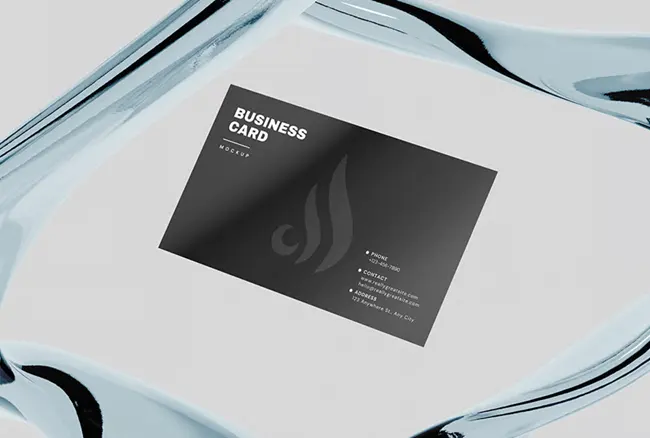
A Google review card is a small printed card — typically business card size or slightly larger — that carries a single message and a QR code. The message asks for a review. The QR code links directly to the business's Google review page. When the customer scans it, they are taken straight to the review form — no searching, one tap.
For trades and service businesses, the card is handed over at the end of the job alongside the invoice or receipt. For restaurants and cafes, it is placed on the table or included with the bill. For salons, it is handed over at checkout. The ask is made passively — the card does the work so no one has to say anything awkward.
The difference between this and asking verbally is that the card stays with the customer after they leave. Someone who does not scan immediately but puts the card in their wallet or bag may scan it that evening or the next day — when they have a moment to actually do it. The window for conversion is longer than a verbal ask.
Getting the Google Review Link Right
The QR code on a review card needs to link to the correct place — not the business's Google Maps listing, but the direct review submission form. The URL format is:
https://g.page/[your-business-id]/review
or the longer format:
https://search.google.com/local/writereview?placeid=[your-place-id]
Your Place ID can be found via the Google Place ID Finder tool. When we design a review card at GotoPrint.ie, we set up and test the QR code link before the file goes to print — so it works correctly from day one.
Table Tents for Seated Businesses
For businesses where customers spend time seated — restaurants, cafes, waiting rooms, salons — a table tent with a Google review QR code is often more effective than a business card. The customer is stationary, they have their phone in their hand or nearby, and the ask is visible for the entire duration of their visit rather than requiring them to remember it later.
A table tent that reads "Enjoying your visit? Scan to leave us a Google review — it takes less than a minute" converts at a different rate from a verbal ask at the end because it removes the awkward moment entirely. The customer who wants to leave a review can do it while they are still in the experience that prompted the feeling.
What a Consistent Review Strategy Looks Like in Practice
For a tradesperson completing three to five jobs per week, handing a review card with every invoice means three to five review requests per week. Even a 20% conversion rate — one in five customers scanning and leaving a review — produces two to four new reviews per month. Over a year, that is 24 to 48 new reviews. A business with 50 recent, genuine reviews dominates local search in most Irish towns for most trade categories.
For a restaurant with 40 covers per sitting, a table tent on every table creates a passive review ask for every seated customer. Even a low conversion rate builds quickly. The reviews arrive without anyone having to say a word.
The investment is a set of business cards or table tents with a QR code — a one-off design and print cost that then works continuously. It is one of the highest-return uses of print for any Irish business with a physical customer interaction.
Get a Review Card Designed